

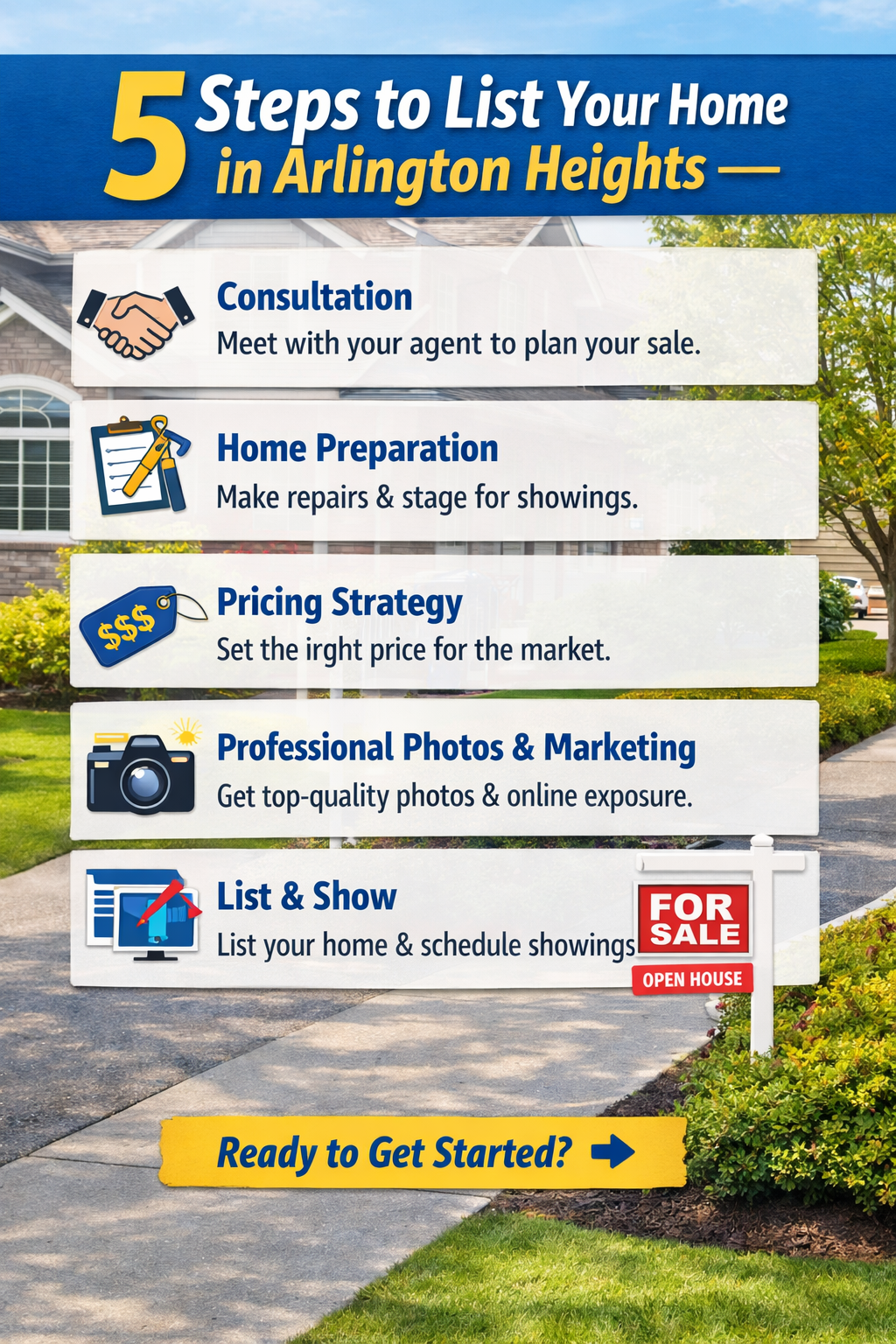
What are the exact next steps to list my home in Arlington Heights?
A step-by-step guide showing the exact process to list and sell a home in Arlington Heights, Illinois.
TLDR
- Start with a data-driven CMA, pricing near recent MLS medians around $450,000.
- Prepare with targeted repairs, light staging, and professional photos within 10–14 days.
- Launch strategically to hit peak buyer traffic, monitor feedback, adjust in week one.
- Use financing tools like rent-backs and bridge loans to protect your next purchase.
What does “listing your home” really mean in Arlington Heights right now?
Listing is more than putting a sign in the yard. It is a tightly managed, data-backed plan to capture pent-up demand, convert showings into offers, and protect your timeline to closing. In late 2025, Arlington Heights sat near a median sale price around the mid-$400s, with active inventory down roughly 15 percent year over year and sale-to-list ratios close to 100 percent, according to MRED (MLS) and local Board data. Fewer listings and steady demand mean buyers are motivated, but they are also value conscious.
Near 11 S Evergreen Ave, the Downtown Arlington Heights core benefits from Metra access and walkability. That translates into strong buyer traffic for well-prepared listings. The U.S. Census puts our village at 75,596 residents with an average commute of 28.2 minutes, signaling ongoing appeal for professionals who want suburban space with efficient city access. See the demographic snapshot at the U.S. Census QuickFacts page for Arlington Heights for context on income, age mix, and commuting patterns.
Here is how I define it as Mike Zapart:
- A competitive pricing strategy anchored to MLS comps and micro-neighborhood trends
- A 10–14 day prep sprint that maximizes perceived value per square foot
- A launch plan that compresses showings and feedback into a decisive first week
How does today’s market shape your pricing and timing strategy?
Your pricing lives or dies by what is selling in your school zone and within one mile of your block. In October–December 2025, MLS data shows Arlington Heights activity concentrated around $400,000 to $500,000, with many homes getting accepted offers in two to four weeks when priced within 1–2 percent of the neighborhood’s last 3–5 comparable closings. List too high and days on market creep up; list precisely and you generate multiple tours quickly.
Nationally, NAR’s market surveys indicate many well-priced homes still see offers inside roughly one month, which aligns with what we see locally. The key is reading the initial seven days correctly. If showings are light or feedback flags a pricing objection, we adjust quickly by a small, surgical amount rather than waiting for staleness to set in. With sale-to-list ratios near 100 percent locally, buyers expect realistic pricing supported by recent comps.
What does the $450,000 pricing band mean for you?
If your home would appraise near $450,000, you have two tactical choices. Price at market to drive broad traffic and potential multiple offers, or price just under market to accelerate days-to-accepted-offer and de-risk your next purchase. I use MRED (MLS) data and an on-site walk-through to weigh condition upgrades, lot attributes, school assignment, and walkability to Downtown. We combine that with macro trends from the FHFA HPI® summary tables and the NAR Realtors Confidence Index to ensure your strategy fits both local and national momentum.
Which neighborhoods matter most for pricing and prep near 11 S Evergreen Ave?
Different pockets of Arlington Heights have distinct buyer profiles. Near our office, Downtown Arlington Heights, Scarsdale, and Pioneer Park remain perennial favorites for access to Metra, restaurants, and parks. North and northwest, Ivy Hill, Greenbrier, and Terramere attract buyers focused on larger lots and District 25 or 214 schools. Price per square foot commonly lands around the mid-$260s to upper-$280s depending on updates and location, per recent MLS patterns.
- Downtown Arlington Heights
– Details – Walk-to-train living near the Metra UP-NW Line and restaurants around Vail Ave and Evergreen brings strong weeknight and weekend showing activity. Condos and vintage homes compete with renovated single-family options. – Watchouts – Parking and noise trade-offs for some blocks. Appraisers weigh condo HOA health and assessments closely. For older homes, buyers scrutinize mechanicals and windows. – Typical timeline – Well-prepped homes priced within 1–2 percent of nearby closings often see solid showings in days one to seven and an accepted offer in two to three weeks.
- Pioneer Park
– Details – Tree-lined streets, parks, and classic midcentury homes. Strong pull for buyers seeking larger lots and proximity to schools and South Arlington amenities. – Watchouts – Comp sets vary by renovation level. For partial updates, I recommend targeted improvements in kitchens and baths to justify a higher price per square foot. – Entry-level path – Light cosmetic refreshes (paint, lighting, hardware) often unlock an additional 3–5 percent in perceived value for budget-conscious buyers.
Across neighborhoods, your micro-location can swing value by tens of thousands. That is why my CMAs slice comps by within one mile, school boundary, and renovation tier, then overlay absorption rates from MRED MLS to determine your most reliable list price.
What are the pros and cons of listing now versus waiting?
Pros:
- Lower competition: inventory down about 15 percent year over year in late 2025
- Strong sale-to-list ratios near 100 percent signal buyers are paying close to ask
- Serious buyers remain active due to job growth and commute-friendly location
Cons:
- Pricing precision is critical: buyers resist over-listing even in tight inventory
- Seasonality can widen days on market outside spring if condition or pricing is off
How do I execute the step-by-step plan for the highest sales price for my home?
A clean, sequenced process removes stress and maximizes outcomes. Here is the workflow I use across Arlington Heights Real Estate listings, from Downtown to Terramere.
1) Strategy session and CMA
- On-site walk-through plus a full CMA from MRED (MLS), matched to your micro-neighborhood and school boundary.
- Deliverable: recommended list price and range, net-proceeds sheet, and 30-day timeline.
- Cost: complimentary consultation.
2) Targeted prep plan, 7–10 days
- Priority items: paint (light neutrals), lighting, deep clean, landscaping touch-ups, hardware swaps.
- Typical costs: handyman and paint $500–$2,000; lighting package $300–$800; deep clean $250–$400.
- Optional pre-listing inspection: $350–$500 to identify fixes buyers may flag later.
3) Staging and media, days 8–12
- Staging consult $200–$400. Light staging for a 3-bedroom often lands $1,000–$2,500 for 60 days.
- Pro photos and floor plan package $200–$350; add video/3D tour $200–$400.
- Goal: create a cohesive look that lifts price per square foot.
4) Pricing finalization and launch
- We set list price within 1–2 percent of the CMA’s matched comps to leverage sale-to-list near 100 percent locally.
- Thursday listing launches capture weekend traffic. First open house within 48–72 hours.
5) Feedback loop, days 3–7
- We track showings, agent notes, and objections. If traffic is light, a quick, data-backed micro-adjustment avoids stagnation.
- In a tight market, motivated buyers often surface within the first two weeks.
6) Offer management and negotiation
- Inspect contract terms beyond price: earnest money, financing strength, inspection and appraisal contingencies, rent-back options.
- In Illinois, sellers typically hire an attorney. Expect $600–$1,200 for attorney fees. Title insurance and transfer-related charges often place non-commission closing costs near 1–2 percent of price.
7) Under contract to close, 30–45 days
- Inspections, attorney review, appraisal, and financing milestones are tracked against hard dates.
- My job is to keep the deal on calendar, avoid scope creep on credits, and protect your bottom line.
8) Buy-sell coordination
- If you are buying next, we can negotiate a rent-back for up to 30–60 days or discuss bridge financing.
- The County’s buyer-focused programs can expand the pool on your sale and help your purchase. Review the Cook County Down Payment Assistance program details, which offer up to 5 percent of purchase price up to $25,000.
One of my clients in Scarsdale needed to buy before selling to secure a rare block. We used a short-term bridge loan, listed within 10 days after targeted paint and lighting, and negotiated a post-closing possession so they could move once their new home closed. Another client near Pioneer Park opted for a pre-listing inspection, invested $1,800 in repairs, and priced directly at the comp-supported number. They had three offers the first weekend and exceeded their target net by 2.3 percent.
If taxes are a concern, explore recent local relief resources that have closed or are periodically renewed. The Cook County Homeowner Relief Fund has offered one-time assistance tied to significant property tax increases, and residents can call 211 Metro Chicago via Cook County for broader housing or financial support resources.
For broader Illinois market perspective as you plan timing, review Illinois REALTORS Market Stats for seasonality and regional trends.
FAQs
1) What is my home worth right now in Arlington Heights? Value depends on your micro-location, updates, and what closed within one mile in the last 90 days. In late 2025, many MLS-tracked sales clustered around the mid-$400s. I combine a MRED (MLS) CMA with a walkthrough to normalize for upgrades and lot appeal, then cross-check with macro trendlines from the FHFA House Price Index to set a precise range.
2) How fast will my home sell if I list this month? Well-priced, well-presented homes often secure accepted offers within 2–4 weeks. Initial seven-day showing activity tells us a lot. If interest is tepid, we move quickly with small adjustments to avoid staleness. Nationally, NAR indicates many appropriately priced homes receive offers within about a month, which aligns with local experience when inventory is tight.
3) How do I sell and buy another home at the same time? You have three primary paths: list now and negotiate a rent-back, secure a bridge loan or HELOC to purchase first, or write a contingent offer with strong proof of funds and a fast-sale plan. We custom model your cash flow and timelines, and we can leverage the Cook County Down Payment Assistance program if it helps your purchase power.
4) What happens if my home does not sell quickly? We revisit three levers: price alignment to the freshest comps, presentation upgrades that cure buyer objections, and marketing reach to hit missed segments. A small, data-backed adjustment in week two or three often re-energizes demand. If the market softens, we can pause to make targeted improvements or explore temporary rental until conditions normalize.
5) How much will it cost to sell my home? Expect commissions plus approximately 1–2 percent in seller closing costs in Cook County, including title insurance, transfer-related charges, and an Illinois real estate attorney (often $600–$1,200). Optional prep costs include paint, handyman work, staging, and professional media. I provide a detailed net sheet at our first meeting so you know your estimated proceeds before we start.
6) Should I do a pre-listing inspection? If your home is older or you have not updated major systems, a pre-listing inspection for $350–$500 can surface issues before buyers find them. Fixing items proactively reduces negotiation friction and keeps you on schedule. We decide case by case, balancing time, budget, and how the findings could influence buyer confidence and appraisal.
7) Do schools and transit impact my price? Yes. District 25 elementary schools and District 214 high schools remain a key driver of buyer demand. Walkability to Metra’s UP-NW line and Downtown amenities near Evergreen Ave boosts showings and value. Demographic and commute context from the U.S. Census QuickFacts supports the long-run appeal of Arlington Heights for professionals and families.
Conclusion
The bottom line Listing successfully in Arlington Heights is a precise, high-leverage process. Start with a CMA anchored to MLS comps, prepare your home with targeted updates and professional media, then launch to capture maximum buyer attention in week one. Pricing within 1–2 percent of the freshest neighborhood sales helps you convert quickly and defend appraisal. If you need to buy next, tools like rent-backs and bridge financing protect your timeline and help you unlock the highest sales price for my home goals. When you are ready, I will tailor a plan that shows exactly how to sell a house in Arlington Heights for the best outcome and how to cash out your home equity confidently.
Written by Mike Zapart — full-time real estate agent specializing in Arlington Heights and Northwest Suburbs of Chicago. Experience: $200+ M sold, certified negotiations expert, Compass Real Estate | License #475.145813
Call or text 224-715-8778
Or check out my YouTube channel with videos about moving to the suburbs https://www.youtube.com/@movingtochicagosuburbs